
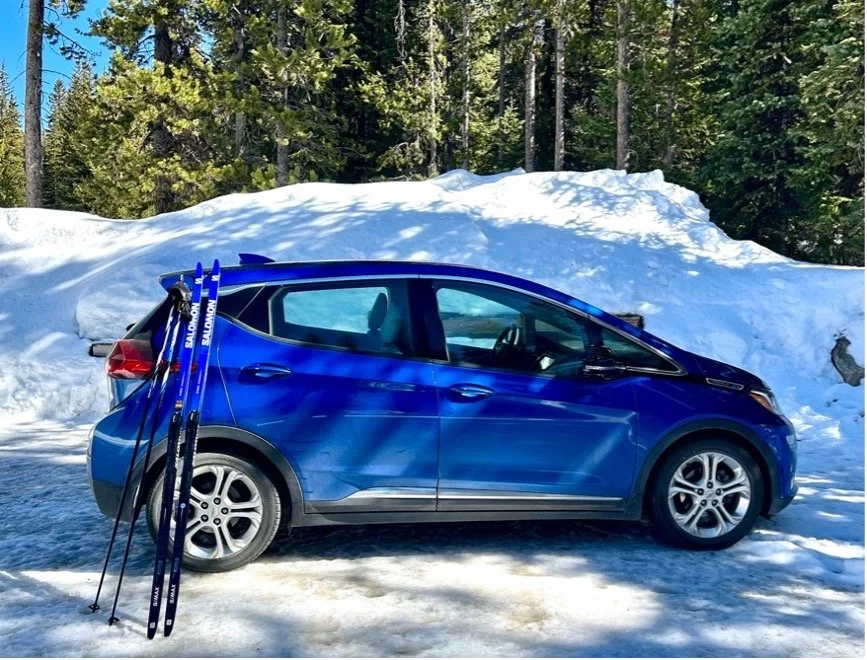
Ski day! 100,000 miles at 7,000 feet elevation.
SEVEN YEARS AGO, I wrote a post about the Electric Revolution that was occurring in the renewable energy and transportation sectors, and our family’s first-year experience driving our 2018 all-electric Chevy Bolt EV. You can find the original article here. We have now driven 100,000 miles with our Bolt – the equivalent of circling the Earth 4 times – so it seems like a good time to post an update.
Overall, driving the Chevy Bolt EV has been a great experience. In fact, the Bolt has been our favorite of all the vehicles we have owned. There are definite trade-offs with driving an electric vehicle (EV), but the concessions have been worth it. I’ll start with the good stuff.
First of all, choosing an EV instead of an internal combustion engine (ICE) vehicle can significantly decrease a person’s carbon footprint. Sure, there are many other major problems vying for humankind’s attention right now, and busy people can only juggle so many things. That said, it’s a mistake to relegate sustainability issues to the back-burner. Along with overcoming today’s many social and political challenges, it is also essential that humankind maintains the bandwidth to tackle pollution and climate change as well.
Social justice and environmental sustainability are co-equal and commingled ideals. Environmental issues often become social justice issues — and that’s because marginalized populations today, and future Earth citizens tomorrow, suffer the greatest consequences from the pollution and climate change that the rest of are presently creating.
Regarding environmental sustainability, there are lots of ways to live a more planet-friendly lifestyle – and driving an EV can be part of that transition. Switching over to an EV from an ICE vehicle is one of the simplest and most impactful ways to help create a sustainable planet. According to a 2024 US Department of Transportation report to Congress, about one-third of all US greenhouse gas (GHG) emissions arise from the transportation sector – plenty of low-hanging fruit to be had here.
Compared to an average ICE vehicle traveling 100,000 miles, our Chevy Bolt EV has saved us from buying and burning about 4,500 gallons of gasoline (using EPA estimates of an average US vehicle getting combined city/highway 22.4 mpg gas mileage). Burning that much fuel would have created around 90,000 lbs. of CO2. That’s a lot.
Along with CO2, there are numerous other dangerous tailpipe emissions streaming out of ICE vehicles – such as methane and nitrous oxide, which are also very potent greenhouse gases. Other hazardous ICE vehicle pollutant emissions include particulate matter, sulfur dioxide (SO2), volatile organic compounds (VOCs), and ground level ozone.
An MIT study showed that air pollution causes about 200,000 premature deaths in the US each year. About one-fourth (53,000) of these premature deaths are due to vehicle emissions. Another one-fourth of these premature deaths are due to power generation emissions. That’s one of many reasons why we need to use electricity derived from solar, wind, hydroelectric, and geothermal sources to power our EVs, homes, and businesses – instead of using energy produced by burning coal or natural gas. Humankind has the capability, if not yet the collective will, to make this transformative change now.
Besides being planet-friendly (as far as cars go), EVs offer many other benefits as well. The Chevy Bolt is surprisingly comfortable and roomy for a small vehicle. And, perhaps better yet, EVs are really fun to drive. EVs have instant torque and rapid acceleration. Push the pedal, and you go – right now! It’s awesome.
_____________________________________________________
Being “planet friendly” is a relative term. There are always some downsides to using any type of resource or energy – even if it is “clean” or “green.” The lithium and cobalt used in EV batteries must be extracted from the Earth. And even if the electricity used to charge batteries all came from solar panels or wind turbines, the materials needed to build these structures must also be mined. Using any form of energy will always exact at least some toll on our planet. There is no free lunch.
The point is that the downsides of burning carbon, for vehicle propulsion or energy production, are far worse than the downsides of using clean and renewable energy options. EVs, solar panels, and wind turbines are certainly not perfect solutions to climate change and air pollution – but they are by far the least dirty shirts in a pile of soiled laundry.
From Leader to Laggard
Nearly a decade ago, Elon Musk rocketed EVs into the future with mass production of stylish and relatively affordable all-electric Tesla vehicles, built in the USA. The global response to EVs has since been fairly positive. However, here at home in the US, the EV revolution has been more of a lukewarm fizzle than an explosive lift-off.
The lackluster US response to EVs is due to multiple factors. The list includes our deeply ingrained oil-driven American driving culture; the willful dissemination of misinformation about clean energy and EVs; and the lack of consistently noble and visionary government leadership regarding sustainability. Compared to many other countries, the US is falling far behind. China is blowing us away with their EV technology and adoption rates – but they’re not the only ones.
Last year, Reuters reported that 96% of all new cars purchased in Norway were fully electric vehicles. This compares to less than 8% in the US. And Norway is a nation with a very cold climate, which significantly impacts battery operation and EV range.
Norway once again wowed the world at the 2026 Winter Olympic games – 18 gold medals and 41 total medals – beating out the USA to take first place. But they are absolutely trouncing us when it comes to transitioning to clean and renewable energy.
We might not ever be able to cross-country ski as well as our Norwegian friends…but 96% EVs this year vs our 8% EVs? That kind of thrashing really hurts – because this is something that we can equal them at.
What about EV Expense, Range-anxiety, and Inconvenience?
Three of the main reasons that US citizens give for not driving an EV are: expense, range-anxiety, and lack of convenience. The first two are not great arguments. Regarding expense, total costs (purchase price plus operating costs) over the life of the vehicle are often less for EVs than for ICE vehicles. Regarding range, there are now numerous charging stations widely available. And new EVs presently offer larger batteries and improved aerodynamic and design efficiencies – which adds range, and alleviates a lot of possible range-anxiety. Lack of convenience can definitely be an issue, but even that is markedly improving. Let’s talk about each of these potential concerns.
EXPENSE
First of all, even if it did cost a little more money to drive an EV, we might all consider driving one anyway. Not every decision is a financial decision. Our personal pocketbooks matter, certainly, but there are bigger issues at play here. Saving lives, and creating a healthy planet for our kids and grandkids, are ideals worth spending a few bucks on. That said, here is something that many people may not be aware of: Buying an EV instead of an ICE vehicle can often save money in the long run.
The upfront costs are indeed presently greater for EVs. The MSRP is roughly $7,000 more for a 2026 Chevy Equinox EV base model than for the gasoline-powered base model. The recently discontinued $7500 US federal tax credit for EVs did help level the playing field. However, due to continuing innovation, the price discrepancies between EVs and ICE vehicles will continue to diminish even without government help – and they could even reverse. Batteries, the major cost contributor for EVs, continue to get less expensive due to new technology and economies of scale.
The maintenance costs of EVs are much less than for ICE vehicles, usually resulting in savings of a few thousand dollars or more over the life of an EV. Of note, other than replacing tires, we have had zero maintenance costs with our Chevy Bolt in the first 100K miles. That’s right…zero.
Fuel costs are also markedly lower for EVs. All factors considered, over the life of an EV, in most instances you can expect thousands of dollars in fuel savings when compared to driving a similar ICE vehicle.
Some details about EV maintenance and fuel costs:
The lower maintenance costs of EVs are due to multiple factors: EVs don’t need oil changes; EV brake pads last 2-3 times as long as normal due to regenerative breaking; there is no exhaust system to worry about; there are far fewer moving parts to repair in electric motors compared to internal combustion engines; and there is no concern about very expensive repairs for broken timing belts or blown head gaskets – because they don’t have any.
Fuel costs are also much lower for EVs than for ICE vehicles. The exact amount of savings depends on many factors. This includes local variability of gasoline and electricity prices, the make/model of the vehicle driven, the mix of city vs highway driving, and the use of home-charging vs fast-charging.
For a quick back-of-the-napkin estimate of ICE vehicle fuel costs, let’s keep it simple and assume a price of $4 per gallon of gas, and 25 mpg combine city/highway mileage for an ICE vehicle traveling 100,000 miles. That comes to a total of 4,000 gallons of gas, at a cost of $16,000.
In my community, our electricity comes from clean and renewable hydroelectric power – and it is really inexpensive (around 7 cents per KWH). This means that, at my home, I can plug into our garage wall outlet (a Level 1 charge) and fully charge a 66 KWh battery for $4.62; which provides around 260 miles of range for our EV. This comes to about $18 to drive 1,000 miles, and about $1,800 to drive 100,000 miles, if I always charged at home.
Compared with $16,000 for an ICE vehicle, that’s $14,200 in fuel savings after driving 100,000 miles. That said, US electricity costs are higher in most regions than in our area. Using the US average electricity price of 17.24 cents per KWh, EV electricity costs to drive 100K miles would be about $4400; still representing about $11,600 in fuel savings compared to an ICE vehicle – which is still a lot.
Level 2 public charging is sometimes free, but it usually averages about 25 cents per KWh. These are the charging stations that you may have seen at hotels, parks, and shopping areas. If all of our charging was done at this rate, the cost would be about $6400 for 100K miles of travel (still representing $9,750 in fuel savings compared to an ICE vehicle).
Level 3 DC fast charging (needed for long distance traveling) averages about 50 cents per KWh. If all of our charging was at this rate, the cost would be roughly $13,000 for 100K of travel (with $3,000 in fuel savings compared to an ICE vehicle).
Of the 100,000 miles driven with our Chevy Bolt, I estimate that about 80% of our charging has been at home (costing about $1,500), and about 20% on the road with DC fast charging (costing about $2,500). This comes to total electricity costs of around $4,000 – so roughly $12,000 in fuel savings so far compared to an ICE vehicle getting 25mpg combined city/highway. The savings are less when compared to more fuel-efficient ICE vehicles. However, even when compared to driving a 2026 Prius (combined city/highway 57 mpg mileage), there would still be a fuel savings of around $5,000 at 100K miles by driving our Chevy Bolt EV instead.
The equations will change in the future, depending on the relative prices of electricity and gasoline. Today, in my family’s experience, the maintenance and fuel savings have easily erased the higher upfront cost of our EV.
Saving money might not be a primary motive for buying an EV – but it is a nice added perk.
A couple of other possible EV expenses to keep in mind:
EVs have historically been more expensive to insure than ICE vehicles. The EPA website states that EVs are every bit as safe to drive as ICE vehicles. And EVs are actually also much less likely to catch on fire. However, some insurance companies do have concerns about higher repair costs for EVs. This is due to possible longer labor times for repairs, lack of EV-experienced mechanics, and possibly more expensive and less available parts – all of which are becoming less of an issue as EV ownership becomes more commonplace. Of note, just like with ICE vehicles, luxury brand EV models will of course cost more to insure than less expensive EV models.
Our previous car insurance company charged significantly higher rates for EVs – so we switched insurers. Our current insurance company charges us a rate very similar to ICE vehicles. Check with your insurance agent before you buy.
Another thing to know is that EV batteries are currently extremely expensive to replace if not under warranty, with costs reportedly ranging anywhere from $10,000 to $20,000. The good news is that EV manufacturers generally offer great battery warranties (GM did a massive recall of early model Chevy Bolt batteries and replaced them for free).
That said, most EV batteries can be expected to last the life of the car, and they can be recycled after that. A Tesla study estimated that there is only about 15% degradation in battery range after 200,000 miles. And here is some more good news: Battery prices are expected to significantly drop in the next 5-10 years.
There are some studies that report very little difference between EV and ICE total cost of ownership – and some cost comparisons even favor ICE vehicles. However, these studies typically factor in depreciation costs. Used EVs have historically depreciated more quickly than used ICE vehicles; but studies often measure depreciation early on, such as at only 5 years (and 75,000 miles) after purchase. Many EVs can easily last 2-3 times that long – and EVs will likely eventually win most overall cost comparisons when measured over the life of the vehicle.
As the cost differences are often relatively small, finances should not play the major role when choosing between an EV and an ICE vehicle. Buying an EV could save you some money in the long run. But even if it didn’t, it can still be worth it to help protect our planet.
RANGE ANXIETY
Range-anxiety is not much of an issue in densely-populated regions, as there are usually many places to get a charge. There are now also lots of charging stations available along rural highways and interstate freeways – and plenty of smart phone apps to help you find them.
However, you still have to be mindful when driving an EV, and you should have a charging plan before traveling long distances in rural areas. This includes having a back-up plan, just in case the charging station that you planned on using is not working. A poorly-functioning charging station was a fairly common event in the past, but it is now becoming more of a rarity. Check charging station updates on your app before you go.
Of note, Tesla has opened its vast fast-charging station network to other vehicles, and adaptors can be purchased for vehicles that use different charging systems. This adds another level of security for long-distance traveling.
If a DC Level 3 fast charger is not working, in metropolitan areas you can usually easily find another station. In rural areas, Level 3 charging stations are spaced further apart, so malfunctioning chargers could become an issue. However, many of these areas also have Level 2 chargers available at parks, campgrounds, and some hotels and other businesses. A Level 2 charge will be much slower – about 25 miles of range per hour of charge – but a few hours of charging could give you enough range to get to the next DC level 3 fast charger.
In most cases, it’s best not to drop below 10-20% battery charge, especially in lightly-populated areas. It’s also a good idea to travel with your charging cord on board. In an emergency, it would be always possible to stop at a local business and ask to plug into a standard 110-volt wall outlet for a Level 1 trickle charge. You could have to wait up to 5 hours to get 20 miles of range, but it would work in a pinch.
Part of being mindful means to pay attention to extremes of wind, temperature, elevation changes, and driving speed. A stiff headwind will significantly decrease range – as will gaining elevation, such as when driving over a mountain pass.
Warm (but not hot) temperatures increase battery range – however, using air-conditioning is a big power drain. On a warm spring day with the windows down, our 2018 Chevy Bolt range is really good (up to 300 miles when driving 55 mph). On a hot summer day, at 100 degrees F and the AC on…not so much. In general, EV range is optimized at about 70 degrees F.
Cold temperatures are usually the bigger problem, as today’s batteries don’t perform as well when cold – and using the heater to warm the cabin is a huge power drain. This is not a big deal on shorter trips; but it is something to consider on longer winter adventures. It helps to pre-warm the car cabin before the trip, dress warmly, and use seat heaters if the vehicle is equipped with them.
____________________________________________
A study by AAA showed the following effects of heat and cold on EV range; both with and without cabin temperature controls on:
At 20 degrees F: 12% loss of EV range. But this increases dramatically to 41% loss of EV range with the cabin heater on (cabin heating decreases range much less with ICE vehicles than with EVs, because ICE vehicles can re-direct engine heat).
At 95 degrees F: 4% loss of EV range. This increases to 17% loss of EV range with the AC on.
___________________________________________
Remember, the vast majority of driving trip distances are well within the range of most EVs. Most people don’t take a lot of long road trips on windy and sub-freezing winter days over high elevation mountain passes – but if you do, you need to plan carefully.
Driving speed also has a very large impact on range. Wind resistance markedly increases with increasing speed. As a rough estimate, increasing driving speed from 60 mph to 70 mph can reduce EV range between 15-20%, depending on your vehicle’s aerodynamic design. So, driving that extra 10 mph faster means losing around 50 miles or more of range for an EV with a range of 320 miles – possibly a real problem in regions where charging stations are widely spaced apart.
By the way, speed matters for ICE vehicles, too. Fuel efficiency drops roughly 7% for every 5mph of additional speed over 55 mph. Recall that less fuel use means fewer emissions – which means less climate change and less pollution.
CONVENIENCE
As much as I would like to say that EV charging is always convenient…it’s just not…unless you always charge in your home garage – which is a breeze. There are far more gas stations than there are EV charging stations. Gas stations are also more reliable. And it takes much longer to charge an EV than to fill up a gas tank.
Our 2018 Chevy Bolt has 8-year-old technology, so it charges slowly, even at “fast” chargers. From about a 10% charge level, in my experience I can usually add about 100 miles of range in about 30-35 minutes of charging – and I can add another 100 miles of range in roughly another hour of charging. This slow rate of charging is not that big of an issue for trips involving only one (or maybe two) charging stops, but the 2018 Bolt is not ideal for longer adventures.
With newer EV models, charging times are getting much faster (they are still not fast compared to refueling an ICE vehicle). The Kia EV6 can reportedly charge from 10-80% in as few as 18 minutes – but it could take a little longer, depending on the station. The 2026 Chevy Equinox EV (range 319 miles) is less expensive than the Kia EV6; however, it charges more slowly, reportedly taking about 50 minutes to charge from 10-90%.
Overall, driving a new EV on a 500-mile trip could take about 2 hours longer than it would in an ICE vehicle (50 minutes of charge time added to about 70 minutes of extra drive time – if you wish to maximize range by driving 60 mph instead of 70 mph).
_______________________________________
Driving more slowly can save lives. An Insurance Institute for Highway Safety (IIHS) study found that 5% increases in maximal speed limits on freeways and interstates were associated with an 8% increase in traffic fatalities. Speed kills.
______________________________________
In case you were wondering why EV manufacturers usually report only the time it takes to charge up to 80% or 90%, it’s because to go from an 80% charge to 100% charge takes about as much time as it takes to get from 10% to 80%. As the battery gets closer to full charging capacity, EV vehicle computers automatically slow the charge down to protect the battery. So, unless you need the extra miles on a long trip, it is often more time-efficient to charge only to 80%, and then move on to the next charging station.
_________________________________________________
There are no hard and fast rules, but friendly charging etiquette generally dictates stopping charging at around 80-90% capacity if all stations are occupied, and other people are waiting in line to charge their vehicles.
__________________________________________________
Traveling across the entire US in an EV is possible – but it is presently inconvenient enough that most people probably wouldn’t want to do it. Fair enough.
That said, it’s not a huge sacrifice to add about 2 hours of time to a 500-mile trip, especially since you can stretch your legs and grab a meal while the car is charging. 2 hours is less time than the average American spends on social media each day. And really, how many 500-mile road trips do most people take in a year?
Especially for two-car families, it makes a lot of sense to have at least one of your vehicles be an EV. If you decide to take your EV on a longer road trip, try to make it fun. Slow down and enjoy the drive. Take in the scenery, and welcome this relaxed and leisurely part of your adventure!
______________________________________________
Whenever any of us burn a lot of carbon – such as when we turn on an ICE vehicle ignition – we can try to bring it all home a bit; imagining what the possible consequences might be for something we care a lot about.
Personally, my mind often goes to the brilliant color and beauty of ocean coral reefs – which are currently imperiled. Greenhouse gases emitted from our vehicles increase ocean temperature and ocean acidity; a deadly double-whammy for coral structures. Coral have thrived on our planet for 25 million years. Exquisitely beautiful in their own right, they are also an essential home to a fantastic menagerie of fishes and other aquatic life. Indeed, 25% of all ocean species are dependent on coral reefs.
But now, on our watch, many of Earth’s magnificent coral reefs are bleached and dying. And this is because of our actions. With business as usual, coral reefs will likely be all but gone by the end of this century. That would mean 25 million years of wonder, destroyed by a few generations of humans. This new reality makes me think a little differently – and hopefully makes me act a little differently, too.
We can easily avoid “business as usual.” We just all have to make a few simple sacrifices.
__________________________________________________
It might not make sense for a person to trade in their ICE vehicle if they just recently purchased one. But it also doesn’t make sense, at least to me, to ever buy another new ICE vehicle. If you are not quite ready to pull the trigger on buying an EV, know that battery technology is expected to advance quickly in the next couple of years, with EV ranges getting longer and charging-times getting shorter.
In the meantime, you can consider driving your ICE vehicle a little less often and a little more slowly. This will lower tailpipe emissions, and help protect the lands, seas, and atmosphere of our Earth for our children’s generation. You can also strongly consider joining the Electric Revolution by making your next vehicle purchase an EV.
Thanks for reading. Just like seven years ago, I will finish this post with a little Beatles nostalgia.
REVOLUTION
You say you want a revolution
Well, you know
We all want to change the world
You tell me that it's evolution
Well, you know
We all want to change the world
But when you talk about destruction
Don't you know that you can count me out
Don't you know it's gonna be
All right, all right, all right
You say you got a real solution
Well, you know
We'd all love to see the plan
You ask me for a contribution
Well, you know
We're doing what we can…